Hundred Horses & Eight Horses: Selecting Horse Motifs for 2026
10/01/2026
The Year of the Fire Horse 2026 is symbolized by the horse—a figure long associated with movement, opportunity, and smooth progress in East Asian culture. In Lunar New Year Gift Box design, horse motifs serve not only as decorative elements but also as a symbolic language of feng shui, conveying blessings, guiding positive energy, and reflecting a brand’s vision.
In contemporary design practice, the two most popular and impactful horse themes are “Hundred Horses” ( 百马) and “Eight Horses” (八马). Each theme carries distinct aesthetic qualities and feng shui meanings, tailored to specific objectives, target audiences, and stages of brand development.
This article introduces classic horse imagery that forms the foundation of these two themes. It also analyzes their feng shui significance and provides guidance on selecting horse motifs that ensure Tet gift boxes for the Year of the Fire Horse 2026 are both visually compelling and imbued with messages of luck, prosperity, and success.
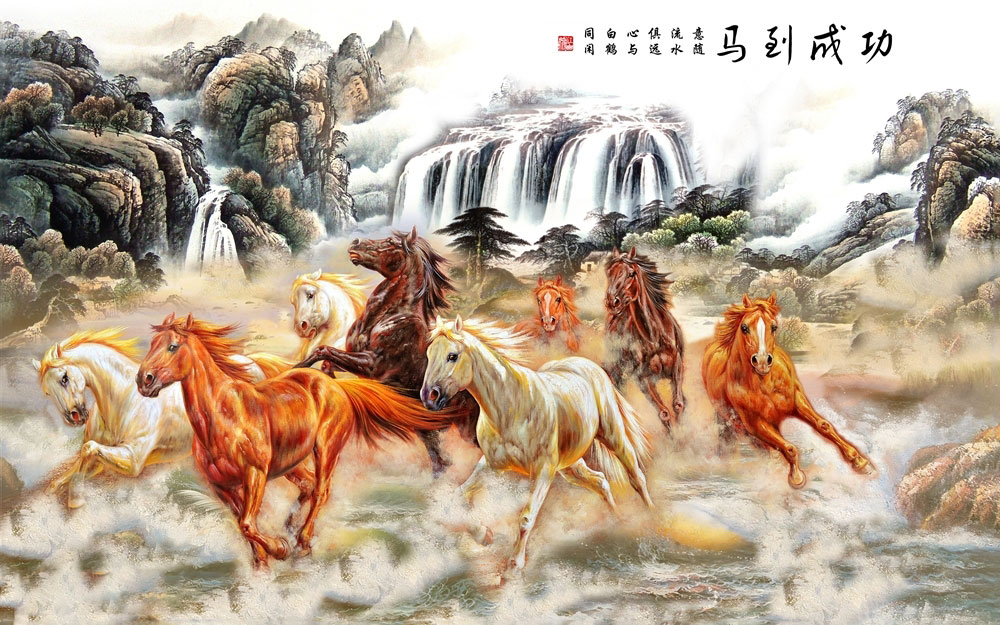
A version of the “Eight Horses Chasing the Wind” theme (八马追风) – source: internet
1. One Hundred Horses 《百骏图》
❖ A Masterpiece of the Qing Court
One Hundred Horses (百骏图) is a signature work by Giuseppe Castiglione (郎世宁, 1688–1766), an Italian Jesuit missionary and court painter active during the Qing dynasty. Castiglione played a pivotal role in 18th-century imperial Chinese art, uniquely blending Western painting techniques with traditional Chinese aesthetics. He served consecutively under three emperors—Kangxi, Yongzheng, and Qianlong—holding a highly influential position within the Qing court.
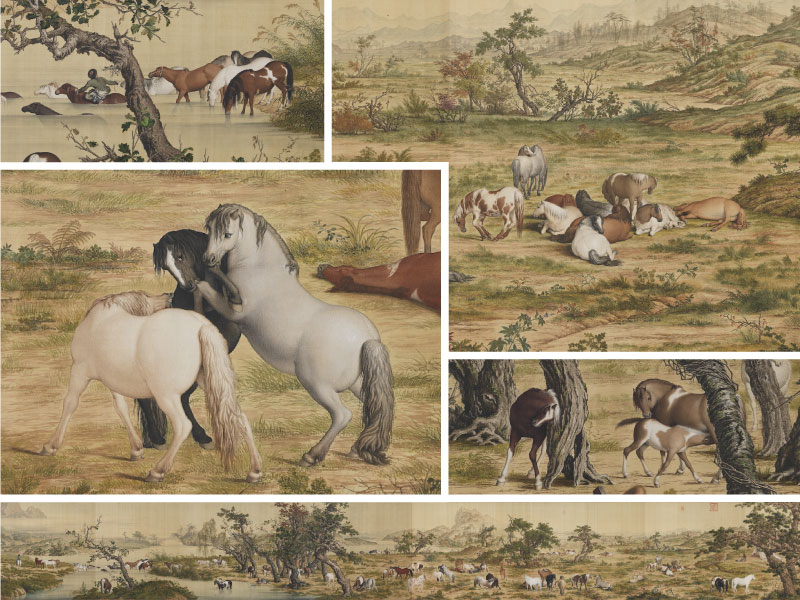
Completed in 1728, One Hundred Horses is a large-scale handscroll measuring approximately 94.5 × 776.2 cm, currently housed at the National Palace Museum, Taipei. The scroll depicts One Hundred Horses across a vast steppe, captured in various postures—standing, lying down, running, and resting—creating a sense of relaxed rhythm and harmonious movement.
Artistic Features
The work exemplifies Castiglione’s distinctive style: he applied Western chiaroscuro and linear perspective to model form, depth, and spatial illusion, while preserving the continuous composition and visual rhythm of traditional Chinese handscrolls. This synthesis produced a new pictorial approach, distinct from classical ink painting yet fully aligned with Qing court aesthetics.
One Hundred Horses is recognized as a landmark in East-West artistic exchange, reflecting ideals of peace, order, and prosperity during the height of the Qing empire.
“One Hundred Horses” (百骏图) by Giuseppe Castiglione (郎世宁, 1688–1766) – source: internet
❖ Applying the “Hundred Horses” Motif in Tet Gift Box Design
Inspired by Castiglione’s One Hundred Horses, the Hundred Horses motif is portrayed as a multitude of horses in calm, orderly, and harmonious arrangements, celebrating strength, nobility, and enduring vitality. The expansive composition and balanced rhythm evoke a sense of stability and completeness.
In East Asian culture, Hundred Horses symbolizes prosperity, peace, and long-lasting stability. The imagery of many individuals coexisting in orderly harmony reflects a cohesive collective that grows and flourishes steadily over time.
When applied to Tet gift box design, the Hundred Horses motif is particularly suited for enterprises with a strong foundation, conveying messages of stability, unity, and continued leadership, while sending wishes for abundant prosperity and lasting success in the new year.
2. Six Galloping Horses 《六骏图》
❖ The Pinnacle of Modern Horse Imagery
Six Galloping Horses (六骏图) is one of the most iconic works by Xu Beihong (徐悲鴻, 1895–1953), widely regarded as the “Father of Modern Chinese Painting.” Xu is best known for his ink paintings of horses, skillfully combining traditional Chinese brushwork with Western anatomical techniques.
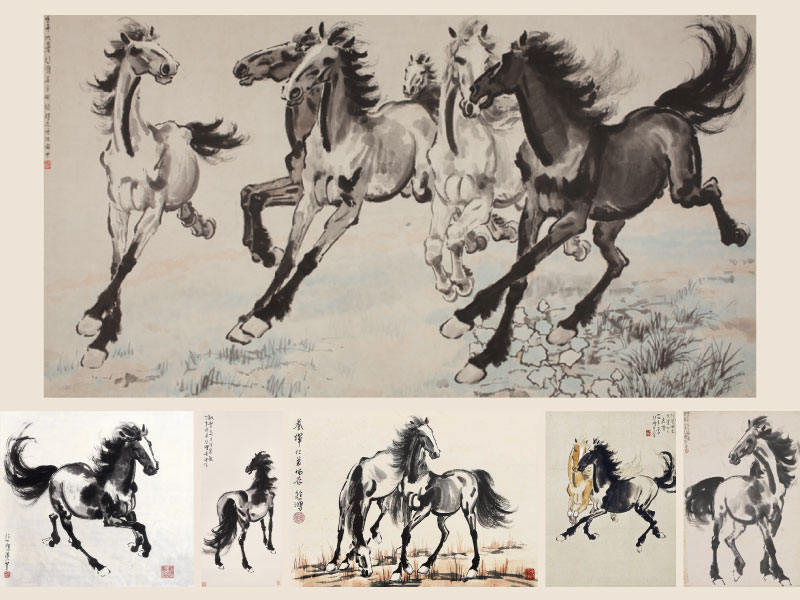
Created in 1942, during a period of war and profound national crisis in China, Six Galloping Horses draws inspiration from “Song of the Heavenly Horse” (天马歌) in the Yuefu Poetry Collection (乐府诗集), an ancient system of ritualistic poetry. The painting depicts six horses in full gallop, bodies thrust forward, muscles taut, hooves pounding, conveying a powerful rhythm of speed and strength. Beyond physical depiction, the galloping horses symbolize enduring vitality, unwavering determination, and the human aspiration to overcome adversity, reflecting faith in the ability to reshape fate even amid historical turmoil.
Artistic Features
The work demonstrates a clear fusion of traditional Chinese ink brushwork with Western anatomical realism, influenced by French Realism. Xu Beihong meticulously rendered the horses’ body structures, muscles, and movements with scientific precision. The composition is dynamically continuous, with forms and directions flowing sequentially, creating a strong visual rhythm and a pervasive sense of motion across the canvas.
Innovative Vision
Xu Beihong revolutionized horse painting by breaking away from the plump, sentimental depictions of the Qing dynasty, creating the galloping horses (奔马) — lean, sinewy galloping horses full of inner strength, fighting spirit, and the aspiration for freedom in times of national crisis. The “spirit” of his horses is praised in Du Fu (杜甫)’s classic verse:
“One wipes aside once and for all the common horses of all time.” (一洗万古凡马空)
Six Galloping Horses represents the artistic apex of Xu Beihong’s horse imagery, exemplifying a seamless fusion of Eastern and Western artistic thinking. It established a new standard for modern horse motifs, marking a pivotal shift in Chinese painting from traditional to modern approaches.
“Six Galloping Horses” (六骏图) and other horse paintings by Xu Beihong (徐悲鴻, 1895–1953) – source: internet
3. Eight Horses Chasing the Wind 《八马追风》
Eight Horses Chasing the Wind (八马追风) is a feng shui-inspired painting theme originating from Chinese culture. The motif of eight galloping horses symbolizes speed, collective strength, and the aspiration to conquer new heights.
In the history of Chinese art, there is no single work considered the definitive “original” of this theme. Variations of Eight Horses Chasing the Wind have appeared as early as the Tang and Song dynasties, with artists interpreting the subject flexibly according to their visual language, aesthetic philosophy, and the historical context of each period.
A version of the “Eight Horses Chasing the Wind” theme (八马追风) – source: internet
Vocabulary Analysis of Eight Horses Chasing the Wind
八 – Eight: In East Asian feng shui, the number eight is considered auspicious, phonetically similar to “fa” (prosper), symbolizing success, completeness, and fulfillment.
马 – Horse: Represents strength, speed, courage, and a pioneering spirit.
追 – Chasing / Pursuing: Signifies pursuing goals with persistence and determination, without hesitation.
风 – Wind: Symbolizes maximum speed, freedom, adventure, and dynamic power.
→ 八马追风 – Eight horses racing with the wind: a motif that embodies full strength, ultimate speed, resolute determination, and the aspiration to surge forward.
❖ Origins and Classical Allusions
The Eight Horses motif originates from the legendary Eight Steeds (八骏) of King Mu of Zhou (周穆王, reign c. 10th century BCE), a famed ruler of the Zhou dynasty. According to tradition, King Mu owned eight exceptional horses capable of traveling a thousand miles a day, symbolizing an era of peace, prosperity, and the aspiration to expand the realm. Since then, the Eight Horses have become associated with authority, ideal governance, and smooth fortune.
Each of the eight remarkable horses is traditionally named and represents an auspicious quality:
赤骥 – Red Steed: Speed, breakthrough, and maximum energy.
盗骊 – Black Steed: Enduring strength and unwavering determination.
白义 – White Steed: Integrity, purity, and virtuous talent.
逾轮 – Surpassing the Wheel: Exceptional efficiency and pace.
山子 – Mountain-Crossing Steed: Stability and the ability to conquer rugged terrain.
渠黄 – Golden Steed: Wealth, prosperity, and high status.
骅骝 – Famous Fine Steed: Luck, renown, and radiant beauty.
绿耳 – Green-Eared Steed: Alertness, intelligence, and the ability to seize opportunities.
❖ The Depiction of Eight Horses in Contemporary Painting
In 20th-century Chinese art, the Eight Horses Chasing the Wind (八马追风) motif was reinterpreted with a new pictorial spirit, strongly influenced by Xu Beihong (徐悲鸿). Building on the tradition of Chinese ink brushwork while incorporating Western anatomical techniques and the ethos of Realism, Xu established a fundamentally new visual language for depicting horses: anatomically precise structures, coherent dynamic forms, and a powerful sense of forward motion.
Xu Beihong’s representative horse paintings, particularly Six Galloping Horses (六骏图), are widely regarded by scholars as a visual and conceptual benchmark for modern Chinese horse imagery. Although he did not directly create works specifically on the Eight Horses Chasing the Wind, the dynamic pictorial language of galloping horses that he developed became a critical foundation, profoundly influencing the majority of contemporary depictions of both Eight Horses Chasing the Wind and Wishing Immediate Success Chinese art.
💡 Did You Know?
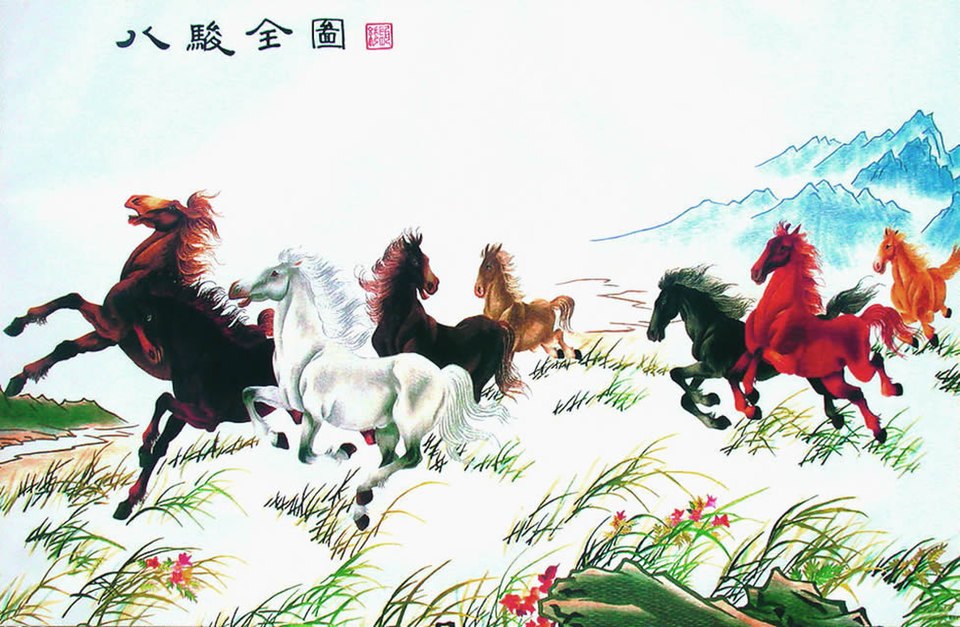
Xu Beihong also created the Eight Steeds Complete Scroll (!)
Although this piece is often mentioned as an extended variation derived from Xu Beihong’s style, its artistic value has not reached unanimous agreement among experts.
Many scholars argue that adding more horses does not enhance the work’s value in the same way as the concise composition of the original scroll. It is in Six Galloping Horses (六骏图) that viewers truly witness the pinnacle of Xu Beihong’s brushwork, epitomizing the spirit of “One wipes aside once and for all the common horses of all time.” (一洗万古凡马空) — where technique and artistic vision achieve perfection.
❖ Eight Horses in the Vietnamese Cultural Context
Through the course of East Asian cultural exchange, the Eight Horses motif, originating from Chinese art, was adopted and localized in Vietnamese culture, both in daily life and in feng shui-inspired art. In Vietnam, this theme is closely associated with the phrase “Mã Đáo Thành Công” (马到成功) — a symbolic expression of well-wishing that conveys a smooth beginning, swift progress, and rapid achievement of success.
Vocabulary Analysis of “Mã Đáo Thành Công”
Mã (马) – Horse: symbolizes speed, strength, initiative, and swift action.
Đáo (到) – Arrive / Reach: implies timely arrival, promptness, and no delay.
Thành Công (成功) – Success / Achievement: indicates a favorable outcome or accomplishment.
Component
Symbolic Meaning
Logical Implication
Mã (马)
Swift
Strong initial momentum
Đáo (到)
Immediate arrival
Reach the target instantly, without delay
Thành Công (成功)
Instant result
Success achieved immediately
Thus, Mã Đáo Thành Công 《马到成功》 conveys:
🇺🇸 Meaning: To succeed immediately upon starting.
Common wish: Wishing immediate success!
Formal wish: Wishing success from the very outset!
💡 Did You Know?
Vietnam also has its own classical allusion for Mã Đáo Thành Công
In the spring of the Kỷ Dậu year (1789), after decisively defeating the Qing army in the Ngọc Hồi – Đống Đa campaign, the Tây Sơn army, led by Emperor Quang Trung, returned triumphantly to Thăng Long. According to folklore, on the way home, the emperor came across the Nhật Tân peach gardens in full spring bloom. He selected the most beautiful branch and entrusted it to a rider to carry back to Phú Xuân, as a messenger to announce the victory to Princess Ngọc Hân, daughter of the Lê dynasty and at that time the Right Consort Empress.
This anecdote is considered one of the most symbolically rich stories of the romance between Ngọc Hân and Nguyễn Huệ. Although it is not recorded in official historical chronicles, the tale has endured in folk memory, reflecting a continuity of history beyond dynasties, national sentiment transcending geography, and the aspiration for a peaceful, reunited spring across the realm.
The image of the swift horse delivering the victory message thus became a distinctly Vietnamese version of “Mã Đáo Thành Công”, embodying speed, success, and cultural identity.
❖ Applying the “Eight Horses” Motif in Tet Gift Box Design
Influenced by Xu Beihong’s Six Galloping Horses, the Eight Horses Chasing the Wind motif emphasizes dynamic movement, depicting a herd of eight horses galloping at full speed with strong rhythm and high energy. This creates a sense of speed, determination, and unstoppable momentum.
In East Asian culture, the galloping horse symbolizes resilient will, extraordinary spirit, and collective strength, while also directly evoking the expression “Mã Đáo Thành Công” — a wish for a smooth start and swift success.
This motif is particularly suitable for Tết gift boxes celebrating promotions, new business ventures, or the beginning of a growth phase, conveying a message of decisive action, early achievement of goals, and sustainable success. At the same time, Eight Horses Chasing the Wind is an ideal decorative motif for housewarming gifts, grand openings, or the launch of new projects.
🔎 Quick Comparison: Hundred Horses vs. Eight Horses
Criteria
Hundred Horses (百马)
Eight Horses (八马)
Character / Mood
Mostly “static”: horses standing, lying, grazing, or strolling leisurely, creating a sense of peace and order.
Mostly “dynamic”: horses galloping at full speed, manes and tails flying, emphasizing speed and kinetic energy.
Background / Setting
Detailed landscapes: willow trees, streams, expansive meadows, forming the continuous space of traditional handscroll painting.
Background usually minimalist, focusing entirely on the movement and power of the horses.
Technique
Meticulous and refined, emphasizing chiaroscuro and Western realistic rendering.
Bold and expressive brushwork, highlighting anatomical structure, muscular tension, and rhythmic motion.
Aesthetic Spirit
Emphasizes order, stability, and overall harmony, reflecting ideals of peace and prosperity in traditional East Asian aesthetics.
Highlights breakthrough momentum, action rhythm, and forward aspiration, associated with freedom of spirit and modern sensibility.
Conclusion
For Tết gift box design in the Year of the Fire Horse 2026, horse motifs should not be chosen arbitrarily or follow short-lived trends — whether in terms of quantity or movement. Instead, their use should be intentional, based on the energy, symbolism, and feng shui message the brand wishes to convey.
Because the horse motif carries deep symbolic meaning and distinctive feng shui energy, understanding and applying it accurately not only helps create a sense of flow and vitality for the product but also allows the brand to demonstrate cultural insight, strategic thinking, and wisdom in visual choices.
👉 Motif: Hundred Horses (百马)
Embodies a static, stable, and cumulative spirit, symbolizing enduring inner strength and the convergence of collective power.
Suitable for established businesses aiming to strengthen internal cohesion, consolidate position, and pursue long-term prosperity.
👉 Motif: Eight Horses (八马)
Represents momentum, acceleration, and breakthrough, conveying dynamic energy and forward drive.
Ideal for individuals or businesses in a startup phase, expanding operations, or entering a new growth cycle, carrying the auspicious message of “Mã Đáo Thành Công” (Wishing Immediate Success).
Understanding the origin, aesthetic quality, and feng shui significance of each horse motif ensures that Tết or gift box designs are not only visually appealing but also meaningful, coherent in message, and appropriate for the target audience. This approach creates distinctive value and cultural depth for 2026 Tết gift designs.
At Newlifepack
With nearly 20 years of experience in consulting and designing gift boxes and Tết packaging, we are a trusted partner helping businesses create distinctive and memorable packaging solutions. We focus on harmonizing aesthetic standards with feng shui principles, delivering subtle, emotionally rich messages that enhance product value and elevate the brand image sustainably.
Newlifepack Co., Ltd.
Professional Paper Packaging Manufacturer in Vietnam (Since 2008) ISO 9001:2015 – ISO 14001:2015 – GMI – GSV – FSC – SMETA
1. What Is a Corrugated Box? The Corrugated Box originated in the mid-19th century as an application of corrugated board and gradually became one of the most widely used packaging solutions worldwide by the early 20th century. Leveraging the inherent advantages of corrugated board, which features a multi-layer structure of flat linerboards and fluted medium, […]
In this feature, Newlifepack presents 12 of the most common rigid box structures—also known as chipboard boxes or cold carton boxes—organized according to Vietnamese–English–Chinese industry terminology. Each structure is accompanied by an analysis of its technical characteristics, structural design, and practical applications. The content is developed as a reference resource to support businesses in selecting […]
Metallic visual cues have a natural, universal appeal—an evolutionary reflex rooted in early humans’ instinct to identify and seek water sources. Consequently, hot foil stamping on packaging and product labels goes beyond visual enhancement, functioning as a strategic value signal that captures attention instantly and reinforces perceptions of quality, premium positioning, and trust at first […]
The year-end period—especially the weeks leading up to Christmas —consistently marks a surge in consumer demand for both gift-giving and self-reward purchases in Vietnam. This seasonal behavior serves as a key driver for occasion-based brands to refresh their packaging, launch Christmas collections, and introduce festive-edition designs that enhance on-shelf appeal and stimulate impulse purchases at […]
Combining material-efficient construction with Japanese-inspired aesthetics, the N-Shiki Roll-end Mailer (N-type Mailer / N式盒) represents a forward-looking packaging solution for the fast delivery market in Vietnam. This article is copyrighted by newlifepack.com. Please share from this site or cite the source when quoting. 1. The N-Shiki Roll-End Mailer N-shiki Mailer (N-type Mailer / N式盒) is […]
Leveraging our high-speed mass-production line for Collapsible Rigid Boxes (可折疊硬盒), Newlifepack introduces the Collapsible Tet Gift Box with Ribbon Tie and Magnetic Closure — a smart, modern packaging solution engineered to optimize both product aesthetics and supply-chain efficiency. This article is copyrighted by newlifepack.com. Please share from this site or cite the source when quoting. […]
Tết Nguyên Đán — the Vietnamese Lunar New Year, commonly known as Tet — is deeply rooted in the tradition of gift-giving, a way to show respect, send wishes of prosperity, and express heartfelt sentiments. As modern life accelerates, Tet Gift Boxes have become the smarter choice for the season — offering sleek, elegant designs, […]




 68 Tran Van Cham Street, Cu Chi Commune, Ho Chi Minh City, Vietnam
 +84 28 3790 2768 |
  +84 828 44 9999 (+zalo)