


30/11/2024
In modern packaging printing, finishing techniques and surface effects such as lamination, embossing, hot foil stamping, and UV coating contribute to a premium, distinctive packaging appearance, while enhancing the perceived value of the product inside.
When applied strategically, the combination of Finishing Techniques and Surface Effects allows packaging to move beyond its protective function and become an effective brand communication tool—supporting brand positioning and creating a lasting impression in consumers’ minds. This is the result of a seamless integration between creative design, advanced printing and finishing technologies, and long-term brand-building strategies.
Join Newlifepack in exploring the most widely used surface effects in today’s packaging printing industry, and discover how each finishing solution enhances product appeal and elevates perceived market value.
© 2026 Newlifepack Co., Ltd. All rights reserved.
Content may be shared for reference with proper attribution to Newlifepack.
DISPLAY CATEGORIES
1. Lamination
2. Foil Stamping & Metallic Knockout
3. Embossing & 3D Embossing
4. Textured Embossing & Refractive Embossing
5. UV Coating & Varnishing
6. Metalized Film Lamination
7. Die-Cutting & Window Patching
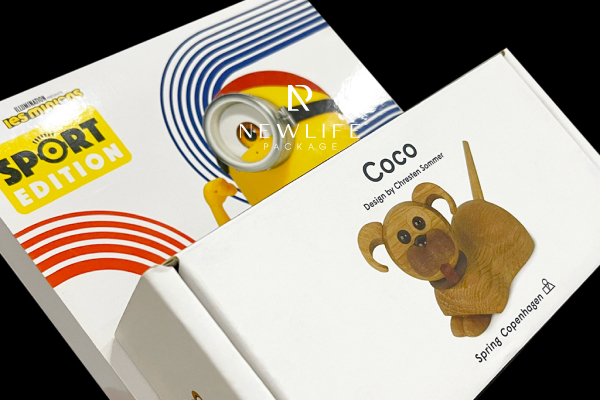
Lamination (Cán Màng | 贴膜) is one of the most widely used surface finishing techniques in paper packaging printing. This process applies a thin plastic film — typically BOPP, PET, or Nylon — that is pre-coated with a hot melt adhesive on one side, and then bonded to the printed surface under heat and high pressure.
The laminated film serves multiple purposes: it protects the printed surface from scratches, moisture, and dust, enhances mechanical strength and durability, and elevates the overall appearance and tactile quality of the packaging.

Hot Foil Stamping (Ép Kim / Ép Nhũ Nhiệt | 烫金) is a surface finishing technique that uses heat and pressure to transfer metallic, pigmented, or special-effect foil layers onto paper. The process employs a heated metal die to press the foil directly onto the printed surface; under controlled temperature and pressure, the adhesive layer on the foil melts and activates, allowing the foil to bond firmly, cleanly, and precisely to the intended areas.
Limitations: Foil stamping requires specialized equipment and custom dies for each design, resulting in longer setup times and higher fixed costs. This reduces design flexibility, limits personalization options, and makes the process less suitable for low-volume orders or urgent production timelines.
Metallic Knockout is the visual effect created by white ink underprinting on metalize paper. This is a modern printing method increasingly used in the premium packaging segment, including pharmaceuticals, cosmetics, dietary supplements, and technology products.
The technique leverages a metallic substrate to produce a metallic sheen through carefully applied layers of white underprint ink. The white underprint layer in this technique acts as a “metallic light control mesh,” determining how much light from the metallic base is reflected toward the viewer.
| Criteria | Full Metallic Zone | Semi-Metallic Zone | Non-Metallic Zone |
|---|---|---|---|
| White Underprint | 0% | >0% to <100% | 100% |
| Effect | Metallic Knockout (VI) Móc Kim, Móc Metalize (CN) 金属敲出 | Metallic Tint (VI) Bán Móc Kim (CN) 金属光泽过渡 | Metallic Blocked (VI) Không Móc Kim (CN) 金属遮盖 |
| Technique | No White (VI) Không lót trắng (CN) 无底白 – no white underprint | Translucent White (VI) Lót trắng tram (CN) 半透明底白 – semi-transparent white | Opaque White (VI) Lót trắng bệt (CN) 不透明底白 – solid white |
| Purpose | Preserve the original metallic surface | Enhance color brightness and create vibrant/neon effects | Create a neutral white base to accurately render printed colors |
Compared to traditional foil stamping, Metallic Knockout creates a similar visual effect without relying on stamping dies, providing greater design flexibility while reducing production time and cost. This technique is especially suitable for products that require frequent design updates or aim to display multiple levels of metallic sheen within a single design.
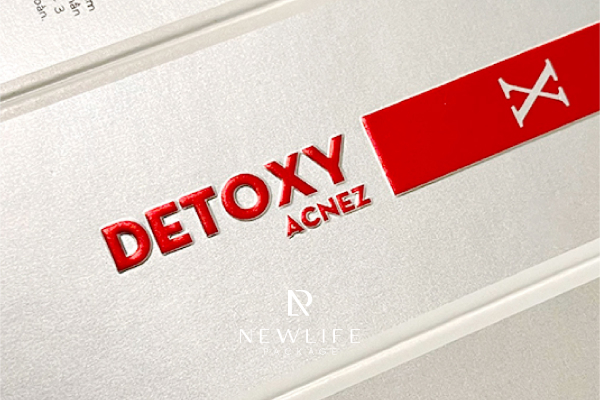
Embossing (Dập nổi | 压凸) and Debossing (Dập chìm | 压凹) are post-printing techniques used to create raised or recessed details on paper surfaces. The process involves pressing the printed sheet between two dies — a male mold and a female mold, or between a die and a resilient rubber counterplate. Under the combined effects of pressure and heat, the paper fibers are reshaped according to the die’s design, forming raised or indented patterns. This technique enhances visual appeal, provides a tactile sensation, and significantly increases the perceived value of packaging.
 Quick Comparison: Flatbed Embossing vs. Rotary Embossing
| Criteria | Flatbed Embossing | Rotary Embossing |
|---|---|---|
| Material Feeding | Sheet-fed | Roll-fed or sheet-fed |
| Pressing Type | Flatbed-to-flatbed | Cylinder-to-cylinder |
| Detail Definition | High precision, sharper detail | High speed, suited for repetitive patterns |
| Production Speed | Moderate | High |
| Best Suited For | Thicker materials, intricate designs | Thinner materials, repetitive high-volume runs |
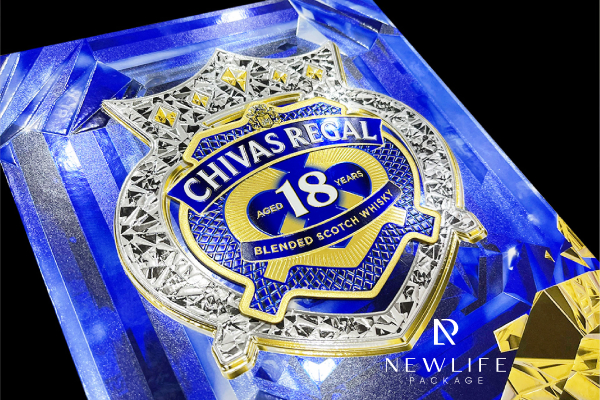
Unlike traditional embossing that creates only single-layer relief, 3D Embossing (Dập nổi 3D | 立体压凸) on Chipboard is an advanced technique that produces multi-level raised effects with remarkable depth and dimensional clarity. The result is a vivid, luxurious, and sculptural surface — as if the image were intricately carved into the material.
At Newlifepack, this technique is performed using specialized hydraulic embossing machines capable of generating high and stable pressure. The metal die set, custom-made according to each design, includes a male mold and a female mold, precisely aligned by a hydraulic positioning system. During the process, the chipboard sheet is pressed between the two dies under controlled pressure and temperature, allowing the image to rise significantly without cracking or damaging the paper surface.
3D Embossing is typically applied to premium rigid box covers, calendar covers, art prints, or large display items. Its strong visual and tactile appeal makes it a signature finishing choice for luxury gift packaging and high-end products, despite the higher mold cost and more complex operation compared to standard embossing.
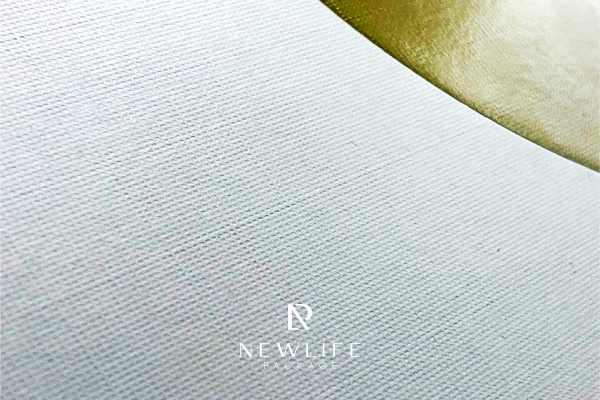
Textured Embossing (Cán vân | 纹理压凸) is a technique used to create fine textured lines or patterns on the paper surface, imitating natural materials such as paper fibers, fabric weaves, or leather grains. This process delivers a refined, organic appearance reminiscent of art paper, adding tactile depth and sophistication to the design.
The effect enhances both the visual and sensory qualities of the product, giving it a luxurious and handcrafted feel — an ideal choice for packaging designs that emphasize texture, craftsmanship, and premium aesthetics.
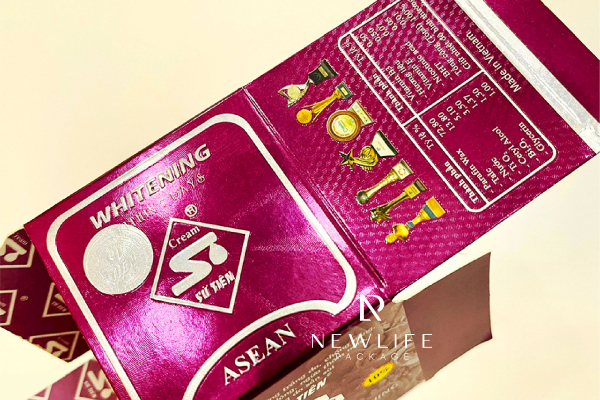
Refractive Embossing (Chiết quang | 折光压纹) is a technique that creates micro-optical patterns on the printed surface or on a post-print coating layer. These patterns generate light-reflecting or light-diffusing effects such as halo lines, radiating beams, or fish-scale textures. The patterns shift in color and reflection depending on the viewing angle, producing a high-tech, modern visual effect while also enhancing the product’s anti-counterfeiting capability.
Although Textured Embossing and Refractive Embossing differ in aesthetic intent and visual outcome, both rely on the mechanical principle of embossing. During the process, the paper or film passes between two rollers — one fitted with an engraved metal pattern (male roller) and the other acting as a counter roller (female roller) or a resilient rubber surface.
As the material passes through the nip under heat and pressure, the engraved design is transferred onto the surface, creating either decorative textures or distinctive optical refraction effects. This technique is widely applied in premium packaging, security packaging, and art prints that demand high visual value and strong brand identity.

UV Coating / Varnishing (Phủ UV / Vecni | UV / 清漆涂层) is the process of applying a thin protective layer to the printed surface, primarily to safeguard the ink, enhance mechanical durability, and elevate the visual appeal of paper packaging or commercial prints.
Depending on the desired aesthetic outcome, cost, and protection level, designers and print technicians can flexibly combine Varnish and UV Coating. This strategic use of surface finishing not only enhances the visual impact but also strengthens brand presence and perceived product value.
| Criteria | Offset Varnish / Oil-based Varnish / OPV | Aqueous Coating / Water-based Varnish / AQ / Dispersion Varnish | UV | Epoxy / Raised Coating |
|---|---|---|---|---|
| Tiếng Việt / 中文 | Vecni offset / Vecni gốc dầu / OPV油性上光油 / OPV | Vecni gốc nước / Aqueous / AQ / Vecni phân tán水性上光油 / 水性涂层 / 分散光油 | UVUV 上光油 / UV 固化光油 | Epoxy / Keo nổi环氧树脂 / 立体滴胶 |
| Coating system | Oil-based (solvent-based / oil-based) | Water-based (water-based) | UV-cured | Epoxy resin with curing agent |
| Drying / curing method | Oxidation & solvent evaporation (slow, ~30 minutes) | Water evaporation & IR heat drying (relatively fast, ~1–5 minutes) | UV photopolymerization reaction (instant, <1 second) | Two-component chemical reaction (very slow, ~6–12 hours) |
| Gloss / Matte | Low – medium Available | Medium Available | Very high Highly visible, well controlled | Very high Not available |
| Flood / Spot | Good Very limited | Very good Limited | Very good Very precise | Not suitable Very precise (small areas) |
| Mechanical durability | Low | Medium | High (scratch & abrasion resistant) | Very high |
| Yellowing over time | Yes | Very minimal | Almost none | Possible |
| Coating thickness | Thin | Thin – medium | Medium – thick | Very thick (raised effect) |
| Suitability for metalize surfaces | Not recommended | Limited | Most suitable | Decorative details only |
| Cost | Lowest | Low – medium | High | High (specialized processing) |
| Typical applications | Books, newspapers, standard brochures | Catalogs, paper boxes, POSM | Premium packaging, liquor boxes, cosmetics | Logos, raised text, accent details |
Quick Comparison: Spot UV Coating vs. UV Drip-off Coating| Criteria | Spot UV (UV định hình / 局部UV) | UV Drip-off (UV 滴落光 / UV 滴釉效果) |
|---|---|---|
| Effect objective | Increase gloss in selected areas, highlighting logos or details | Create a strong gloss–matte contrast. More distinctive than Spot UV in matte-covered areas |
| Number of coating layers | One layer of glossy UV varnish applied to selected areas | Two layers: • Layer 1: Primer / matte varnish applied to selected areas • Layer 2: Glossy UV varnish applied over the entire sheet |
| Visual contrast | High, direct | Very high, strong intensity, creates a modern sense of depth |
| Gloss / matte characteristics | • Bright gloss, strong contrast with uncoated areas • Coating thickness can be increased with raised UV or combined with embossing | • Deep gloss over matte areas • Surface roughness or particle size can be adjusted through technique and materials |
| Tactile feel | Light, primarily a visual effect | Pronounced, adds depth and a premium tactile feel |
| Mechanical durability | Good | Very high |
| Cost | Low–medium | Medium–high |
| Typical applications | Name cards, catalogues, brochures, wedding invitations, logo or detail highlights | Premium packaging, luxury gift boxes, high-end printed materials… |
Quick Comparison: Drip-off Varnish vs. UV Drip-off Coating vs. Hybrid UV Drip-off Coating| Technical Criteria | Varnish Drip-off | UV Drip-off | Hybrid UV Drip-off |
|---|---|---|---|
| 中文 | 光油滴墨效果 / 油性滴墨工艺 | UV 滴墨效果 / UV 滴墨工艺 | 混合 UV 滴墨效果 / 混合 UV 滴墨工艺 |
| Number of coating layers | Two layers:• Layer 1: Matte, spot-coated, using oil-based primer/varnish• Layer 2: Gloss, full-area coating, using water-based varnish | Two layers:• Layer 1: Matte, spot-coated, using oil-based primer/varnish• Layer 2: Gloss, full-area coating, using UV varnish | Two layers:• Layer 1: Multi-texture matte, spot-coated, using hybrid primer / oil-based varnish / water-based varnish / specialty inks• Layer 2: Gloss, full-area coating, using UV varnish |
| Visual contrast | Medium | Very high | Very high |
| Gloss / Matte effect | • Moderate gloss, limited depth• Fine, smooth grain | • Deep gloss• Sand-like texture | • Deep gloss• Diverse matte texture options |
| Tactile feel | Light, smooth transition between areas | Pronounced, sharp transitions | Strong, premium tactile feel |
| Mechanical durability | Medium | Very high | Very high |
| Cost | Low–medium | Medium–high | Typically high due to complex materials and processes |
| Typical applications | Brochures, catalogues, advertising prints | Premium liquor packaging, luxury gift boxes | High-end packaging, luxury gift boxes, difficult-to-finish surfaces |
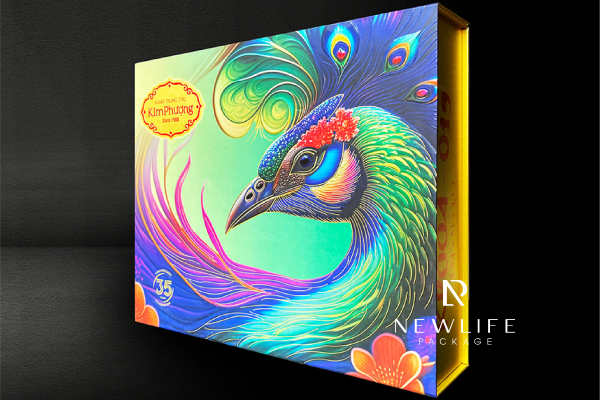
Metalized Film is a composite material consisting of an ultra-thin metallic layer (usually aluminum) deposited onto a polymer substrate such as PET or BOPP through a vacuum metallization process. This metallic layer imparts a distinctive reflective sheen while enhancing key barrier properties — including moisture resistance, oxidation protection, and light blocking.
Metalized Film Lamination (Ghép màng metalize | 金属化薄膜复合) refers to the process of bonding the metalized film onto paper substrates (such as Couche, Ivory, or Kraft) using adhesive or thermal lamination. The result is a metalized paper with a premium metallic finish that not only enhances visual appeal but also strengthens the protective performance of packaging.
After lamination, the metalized paper can be further processed through offset printing and various post-press finishing techniques such as film lamination, foil stamping, embossing, or UV coating to achieve both functional durability and striking aesthetic effects.
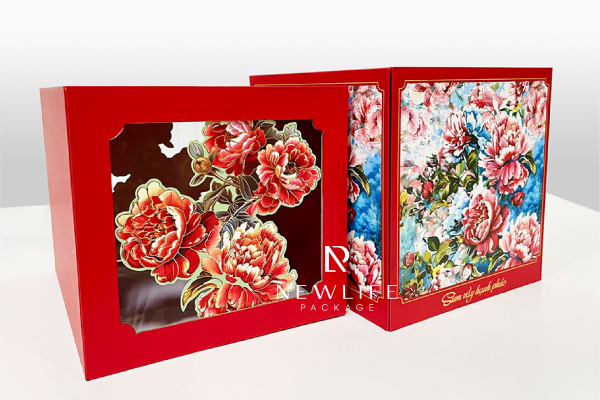
Die-Cutting (Bế khuôn / 模切) is a converting technique that cuts, scores, or creases paperboard or sheet materials into predetermined shapes using a cutting die. It is a critical stage in paper packaging production, enabling the formation of box structures and custom design elements with precision.
In principle, the printed sheet is pressed between the cutting die and the counter plate under high pressure. The blades of the die either cut through the material or create fold lines (creasing) following the exact outline of the design, ensuring clean edges and consistent accuracy across all products.
Window Patching (Dán cửa sổ / 窗口贴膜) is a widely used finishing technique in folding carton packaging production. After the carton surface is die-cut to create an opening (window), a transparent or semi-transparent film — typically PET, PVC, or PP — is applied to the inner side of the board at that position. The film creates a see-through area, allowing consumers to view the product inside without opening the box.
Beyond serving protective and decorative functions, finishing techniques and surface effects directly influence perceived product quality, consumer trust, and purchase decisions at the point of sale. When selected strategically and executed with precision, these effects help products stand out within the same market segment, strengthening brand recognition and memorability.
In an increasingly competitive market, investing in packaging is ultimately an investment in customer experience and long-term brand value. A professional, cohesive, and creative printing and finishing solution transforms packaging into a strategic advantage—positioning it as a powerful, consistent, and approachable “brand ambassador” in the minds of consumers.
Vietnam Paper Packaging Manufacturer (since 2008)
Certifications: ISO 9001:2015, ISO 14001:2015, GMI, GSV, FSC, SMETA
Industrial Design · Printing · Manufacturing
▸ Tet gift boxes, mooncake boxes, gift boxes, packaging boxes, custom packaging
▸ MOQ: rigid boxes 500–1,000, corrugated boxes 1,000–2,000, folding cartons >5,000
Core strengths: Rigid Boxes & Metalized Boxes
▸ High-quality offset printing & metalized printing on KOMORI Lithrone presses – USD 2 million investment
▸ Fully integrated rigid box (chipboard box) production line, no outsourcing
▸ Perfect metalized surface achieved through roll-to-roll lamination with pressure bonding and thermal curing
▸ Signature effects: metallic knockout, drip-off / sand-like, 3D embossing, sculpted foil stamping
Consultation · Quotation · Orders 68 Tran Van Cham Street, Cu Chi Commune, Ho Chi Minh City, Vietnam
 +84 28 3790 2768 |
  +84 828 44 9999 (+zalo)
 box@newlifepack.com (EN / 中文)
 newlifepack.com
 facebook.com/newlifepack


 Đã copy


